For much of the 20th and early 21st centuries, influenza was considered the paradigmatic pandemic virus. This expectation was rooted in repeated historical pandemics, extensive animal reservoirs, and the virus’s remarkable capacity for antigenic change. Yet the pandemic that ultimately tested global preparedness did not arise from influenza, but from a coronavirus. This divergence between expectation and reality necessitates a critical reassessment: while influenza remains a significant pandemic threat, future pandemics will not necessarily follow an influenza-centric script.
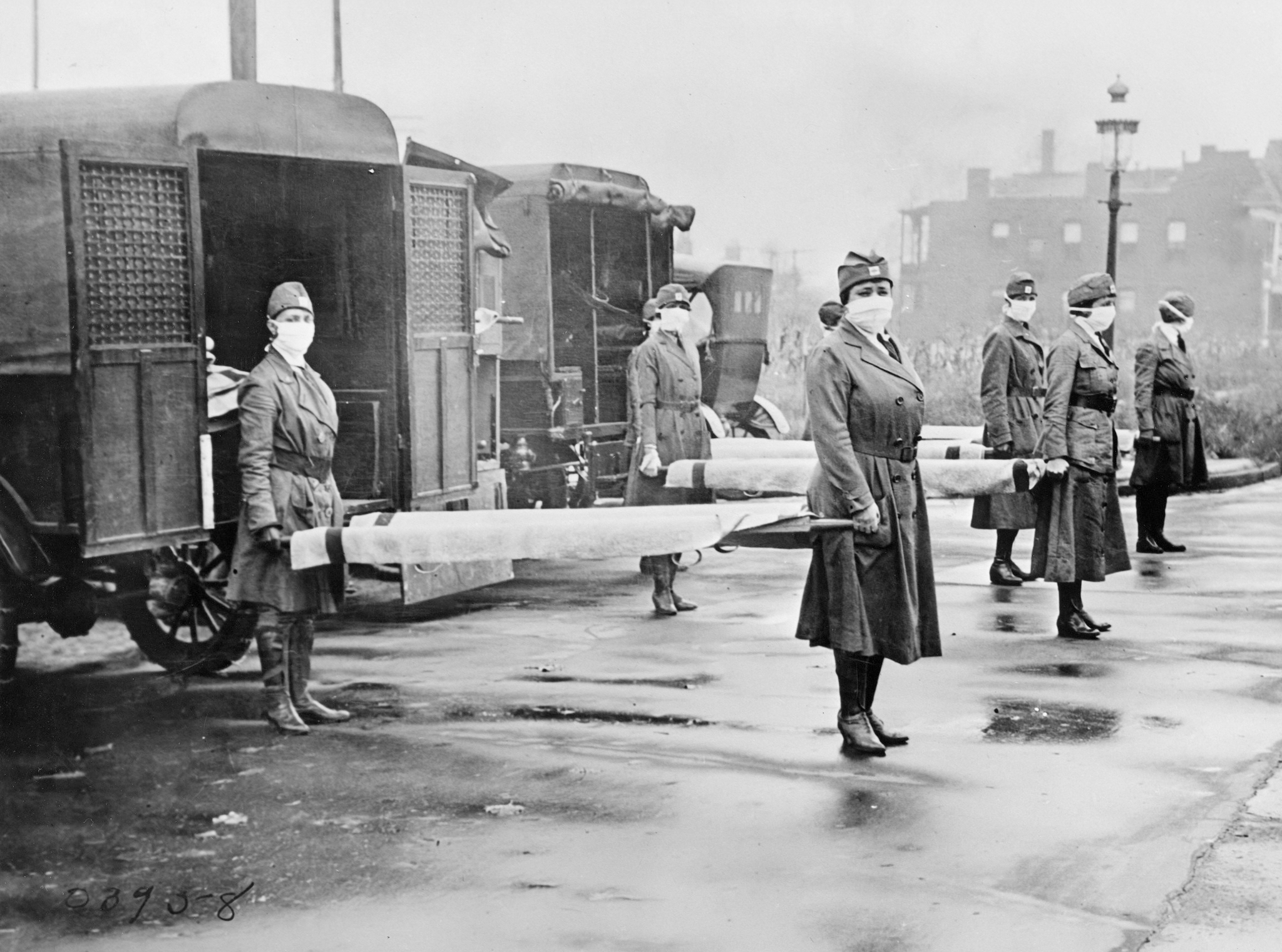
Photography. This October 1918 photograph, depicting St. Louis Red Cross Motor Corps personnel during the influenza epidemic, was also used as the cover image for this issue. Photo Credit: Library of Congress via AP.
The 1918 influenza pandemic, caused by an avian-origin H1N1 virus, remains the deadliest infectious disease event in modern history. It infected approximately one-third of the global population and caused at least 50 million deaths worldwide, exceeding fatalities from World War I itself. In the United States alone, an estimated 675,000 deaths were attributed to the pandemic (1). Several features made the 1918 pandemic both catastrophic and informative:
Mortality patterns were highly unusual, with disproportionately high death rates among young adults—a phenomenon rarely observed in seasonal influenza. The pandemic unfolded in the absence of modern medical countermeasures; diagnostic testing, antivirals, effective vaccines, and intensive care were decades away. Subsequent genomic reconstructions of preserved viral material have identified mutations that enhanced human infectivity and immune evasion, demonstrating the virus’s rapid adaptation following zoonotic spillover. Importantly, descendants of the 1918 virus seeded influenza A lineages, including H1N1 and H3N2, that continue to circulate today, illustrating how pandemics can permanently reshape endemic influenza dynamics.
Influenza A viruses circulate within vast avian and swine reservoirs, and their segmented genome facilitates both gradual antigenic drift and abrupt antigenic shift through reassortment (2). These biological properties underpin influenza’s enduring pandemic potential. Even in non-pandemic years, seasonal influenza imposes a substantial global burden, with estimates of up to 650,000 influenza-associated respiratory deaths annually.
Concerns have been further amplified by highly pathogenic avian influenza viruses, particularly H5Nx and H7Nx lineages, which have caused severe human infections alongside sustained animal outbreaks. These events sustain fears that only limited additional adaptation steps may be required for efficient human-to-human transmission.
In the autumn of 2025, a highly mutated H3N2 influenza variant drove an unusually severe global influenza season. This variant, belonging to subclade K, had not been dominant in recent years but rapidly achieved global prevalence. It contributed to early and widespread infections and hospitalizations in multiple countries, including the United States, the United Kingdom(3), New Zealand (4), Italy, and Japan.
Several characteristics distinguished this variant(5). The variant accumulated numerous key mutations, rendering it genetically distant from strains included in recent influenza vaccines and contributing to immune escape and vaccine mismatch. The 2025–2026 influenza season began earlier than usual and surged rapidly, placing atypical strain on healthcare systems. Despite concerns regarding antigenic mismatch, early evidence suggested that existing vaccines continued to offer protection against severe disease in many individuals.
This episode underscores influenza’s capacity for unexpected antigenic evolution and highlights the intrinsic challenges of seasonal vaccine strain selection. It also serves as a contemporary microcosm of pandemic emergence dynamics. Parallel concerns persist, as avian H5N1 viruses continue their global panzootic spread among wild birds and mammals, with documented reassortment and spillover events across continents, raising ongoing questions regarding future human adaptation potential.
The COVID-19 pandemic demonstrated that pandemic impact is determined not solely by intrinsic virulence, but by transmissibility, population immune naivety, and societal vulnerability. Influenza viruses continue to evolve, and antigenic drift can rapidly undermine vaccine effectiveness even within a single season, as exemplified by the currently dominant H3N2 subclade K.
Influenza may well cause another pandemic, and many experts consider this likely over the long term. However, the next global pandemic may not resemble the 1918 event, may not be caused by influenza alone, and may not conform to predictable severity patterns. Pandemic preparedness must therefore evolve beyond pathogen-specific forecasting. The central question should shift from “Which pathogen will cause the next pandemic?” to “How can health systems remain resilient against a broad spectrum of emerging respiratory threats?” Robust surveillance systems, adaptable vaccine platforms, and sustained global data sharing will be essential components of this strategy.