Three French virologists at the Pasteur Institute in Paris, François Barré-Sinoussi, Luc Montagnier, and Jean-Claude Chermann, are recognized as the pioneers of the AIDS epidemic for their groundbreaking discovery of the etiologic agent of AIDS (1). This discovery has an interesting story. In January 1983, a colleague from the Bichat-Claude Bernard Hospital approached the French virologists, who have been working on retroviruses, with a simple question: “Do you think that this newly emerging disease characterized by immunodeficiency could be caused by a retrovirus?” The colleague also brought a patient with immunodeficiency who had consented to a lymph node biopsy (2,3).
The isolated virus was initially thought to be a type of human T-lymphotropic virus but was later proven to be a novel retrovirus that would shake the earth and cause one of the largest pandemics in history over the subsequent four decades (2,3). The virus was first designated lymphadenopathy-associated virus (LAV) and was renamed as HIV-1 in 1986 (4).
In 2008, twenty-five years after the discovery of HIV, Françoise Barré-Sinoussi and Luc Montagnier were awarded the Nobel Prize in Physiology or Medicine for this achievement. Their colleague, Jean-Claude Chermann, who was the second author of the first publication and the team’s manager, was left out of the awarding process and could not be a recipient of the prize. One year later, he was awarded the Légion d’honneur by Nicolas Sarkozy (4,5).
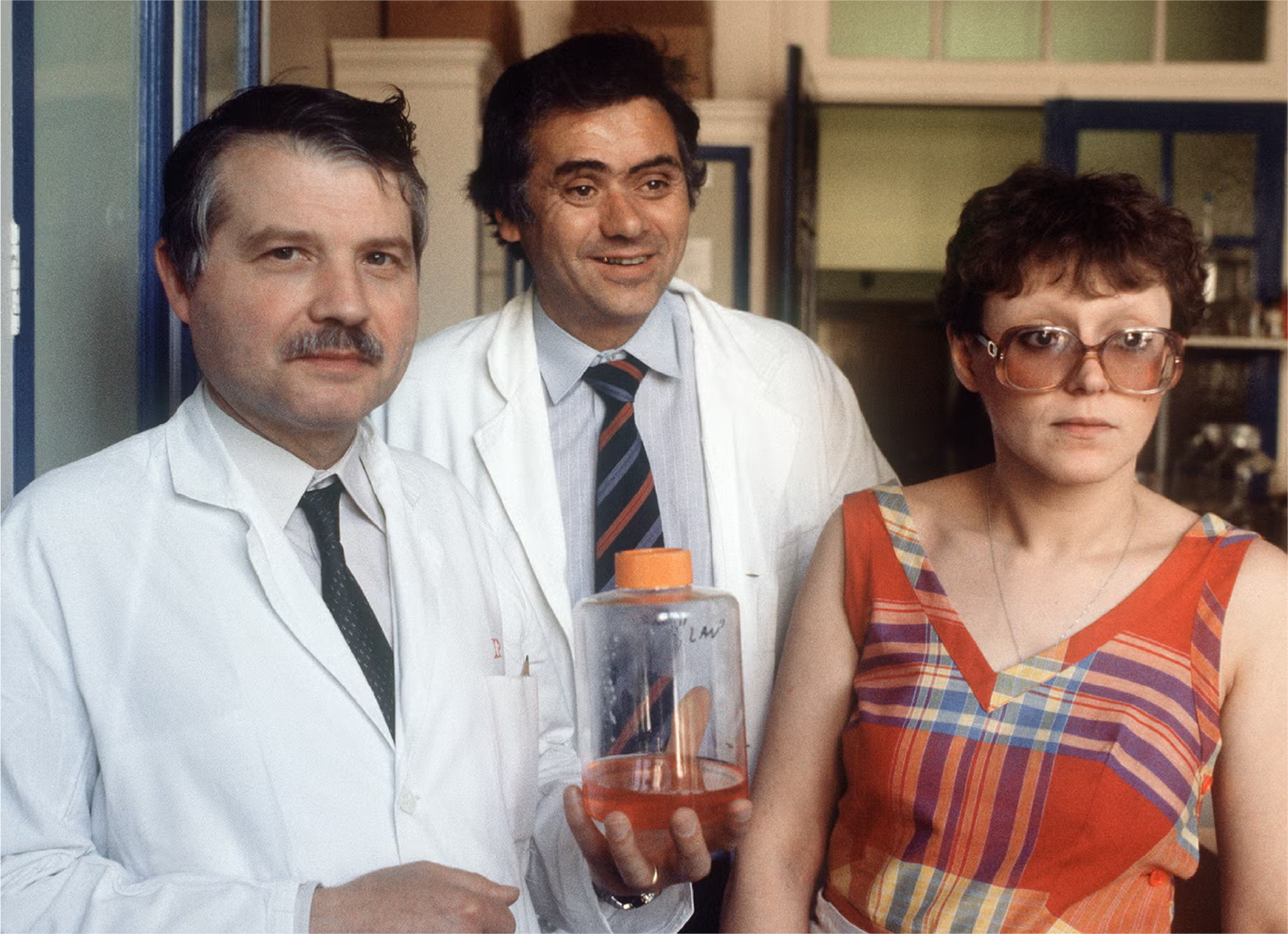
Photograph. Luc Montagnier (left), Jean-Claude Chermann (center), and Françoise Barré-Sinoussi with a jar containing the lymphadenopathy-associated virus, 1984.
Luc Montagnier, the senior researcher of the laboratory, was involved in considerable controversy over priority in the isolation of the virus, as Robert Gallo and his group in the United States (U.S.) also claimed to have isolated it. The dispute continued until an American epidemiologist examining the archived specimens concluded that the U.S. sample had originated from the French laboratory due to specimen contamination (3). In later years, they decided to end the controversy and acknowledge each other’s roles in discovering the virus. Montaigner continued his work on HIV as a co-founder of the World Foundation for AIDS Research and Prevention and co-director of the Program for International Viral Collaboration. However, later on, he focused his work on other areas such as homeopathy, autism, and COVID-19, and was accused of disseminating incorrect messages outside his area of expertise.
Despite being a junior scientist working under the mentorship of Luc Montagnier and Jean-Claude Chermann, Françoise Barré-Sinoussi consistently remained at the forefront of HIV research. She fought every challenge of being in the spotlight as a female scientist while enjoying her success and growing ambition to save as many lives as she could. After establishing her own laboratory at the Pasteur Institute in 1988, she continued her work on basic research and conducted studies on the adaptive immune responses to viral infection (6,7), the role of innate immune defenses (8), factors associated with vertical transmission of HIV (9), and the characteristics of elite controllers (10,11), co-authoring more than 240 publications. Beyond her research, she took on roles as a member or a leader in numerous national and international organizations, received many other awards and honors, brought science to low-resource settings like Cambodia and Vietnam, and served as chair of the International AIDS Society (12,13). During the final years of her career, she directed her efforts toward HIV cure research by launching and leading the “Toward an HIV Cure” initiative.
The isolation of HIV by these three scientists, following a single simple question, opened a path to the understanding of HIV infection and guided further research. Over more than four decades since this remarkable discovery, we have made huge progress in understanding the virus’s biology, the immune mechanisms involved in the infection, and in developing antiretrovirals and prevention tools, and today we are much closer to a cure for HIV infection than ever.