To the Editor,
The recent cluster of Andes virus (ANDV) infection associated with the MV Hondius adventure cruise ship has sparked global concern about the virus’s pandemic potential (1). Cruise ships may provide favorable conditions for examining human-to-human transmission due to prolonged close contact. We reviewed the existing literature to shed light on the subject.
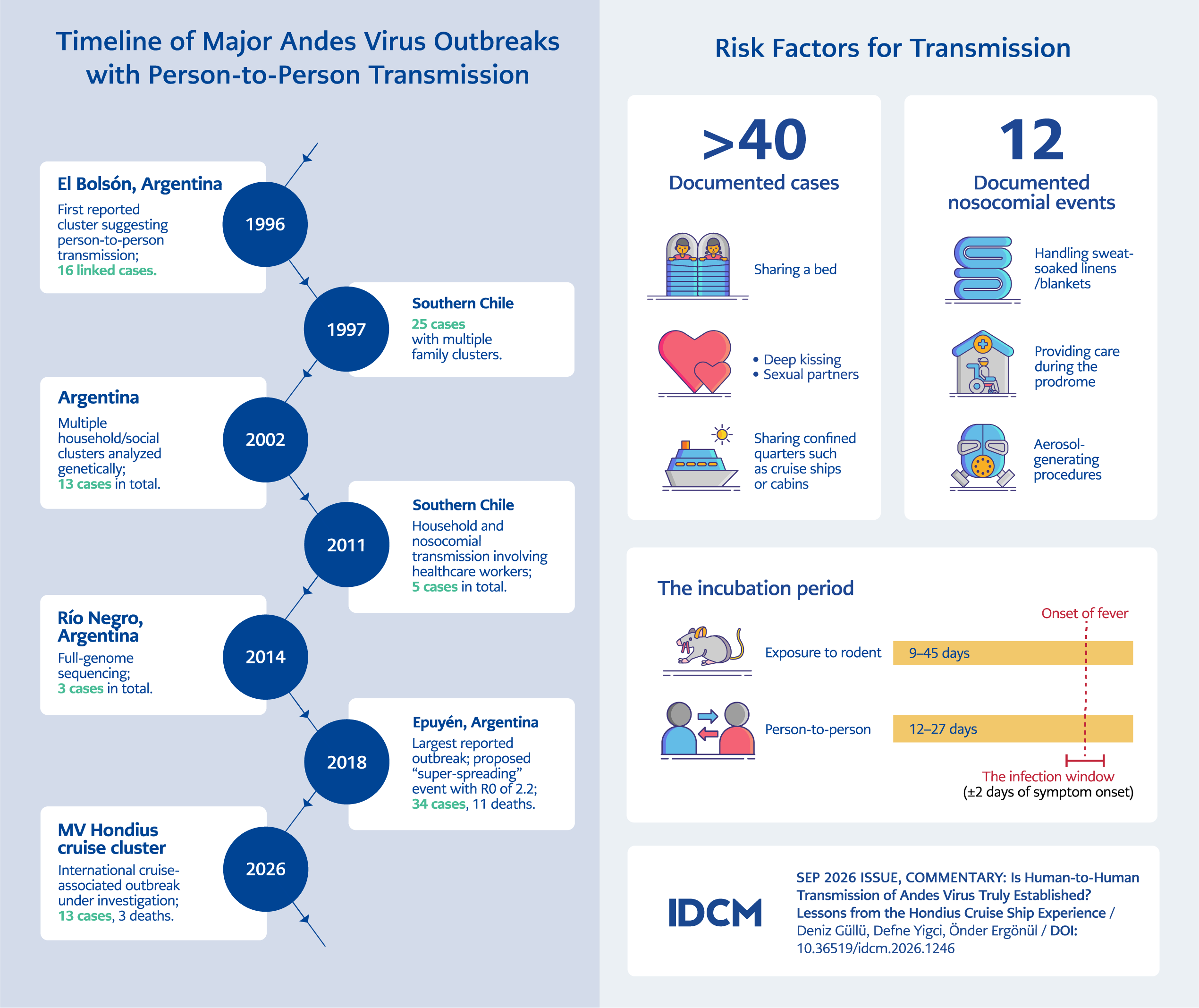
Figure 1. Timeline of reported Andes virus outbreaks and factors associated with human-to-human transmission.
Most hantaviruses are considered strictly zoonotic pathogens. The primary route of transmission is through the inhalation of aerosolized rodent excreta or contaminated environmental particles. However, reports from South America have suggested that ANDV may occasionally spread between humans under specific conditions. Initial reports emerged from family clusters in southern Argentina and Chile during the 1990s (2–4) (Figure 1). Investigators identified infections occurring after prolonged close exposure to symptomatic patients (3). In later years, epidemiologic and molecular studies described additional clusters involving household members, sexual partners, and healthcare workers (5,6). A prospective study from Chile suggested that sexual partners and close household contacts had substantially higher infection risk than non-intimate contacts (7).
The strongest evidence of human-to-human transmission came from the 2018–2019 Epuyén outbreak in Argentina. Martínez et al. (8) described 34 confirmed cases and proposed a “super-spreading” event during crowded gatherings. Using epidemiological reconstruction and genomic sequencing methods, researchers suggested that secondary transmission chains occurred following a single spillover. The authors estimated a median reproductive number of 2.12 before implementation of isolation and quarantine measures, decreasing to 0.96 afterward (8). However, reproduction numbers obtained from relatively small and highly clustered outbreaks are sensitive to assumptions about transmission chains, timing of exposure, and case attribution. During the Epuyén outbreak, transmission appeared disproportionately associated with a limited number of individuals classified as “super- spreaders”. This suggests that social behavior and exposure intensity may have contributed to outbreak dynamics. Accordingly, the estimated reproductive number may reflect the characteristics of the outbreak rather than the intrinsic transmissibility of ANDV itself. It is uncertain whether the reproduction number would be informative in the recent cruise ship-associated cluster. Furthermore, such a high reproduction number has not been reported in other ANDV outbreaks. According to the authors, the human-to-human transmission window of the virus was approximately one day, which may limit opportunities for transmission.
Despite the available evidence suggesting potential human-to-human transmission, important epidemiologic and methodological limitations remain. In endemic rural areas, particularly among socially connected individuals living in close geographical proximity, shared environmental rodent exposure cannot always be ruled out. Recall bias, incomplete contact histories, and uncertainty regarding the precise timing of infectivity challenge retrospective outbreak analyses. The long incubation period of ANDV, which can extend up to 8 weeks, complicates the accurate reconstruction of exposure timelines and transmission chains. Genomic similarity between isolates may support an epidemiological link, but it does not independently prove direct human-to-human transmission, since closely related viral strains can circulate within the same endemic region.
Broader epidemiologic evidence also remains inconsistent. A systematic review by Toledo et al. (9) concluded that comparative studies did not provide strong evidence supporting widespread human-to-human transmission of hantaviruses, although limited transmission could not be excluded. Several seroepidemiologic studies evaluating healthcare workers and exposed household contacts similarly failed to demonstrate markedly increased seropositivity compared with the general population (2,7). In addition, no sustained community outbreaks resembling influenza-like respiratory spread have been documented despite decades of hantavirus surveillance in endemic regions.
Therefore, the MV Hondius cluster offers a significant opportunity to re-evaluate these questions. Cruise ships represent theoretically favorable settings for transmission because of prolonged close contact, shared dining areas, confined social environments, and repeated interaction among passengers and crew members. The outbreak extended from symptom onset in the first probable case on April 2, 2026, to the last confirmed case on May 31, 2026, and was announced as over on July 2, 2026 (1). Since the incubation period of ANDV may extend to 8 weeks, this temporal pattern is compatible with one or more transmission generations. Nonetheless, only 13 cases were identified among 147 passengers and crew members (1). The World Health Organization (WHO) initially estimated the effective reproduction number to be approximately 0.7 (10), consistent with limited transmission. Following completion of the recommended 42-day follow-up, 317 high-risk and 336 low-risk contacts were monitored without identification of additional secondary cases. If ANDV consistently possessed highly efficient human-to-human transmissibility, broader dissemination might reasonably have been expected in such conditions. Instead, the restricted extent of spread may suggest that transmission requires highly specific epidemiologic circumstances or intense close exposure rather than routine casual interaction.
Interpretation of the cruise-associated cluster remains complex. Some of the passengers reportedly participated in outdoor excursions and hiking activities in South America before symptom onset, introducing the possibility of rodent-associated environmental exposure before embarkation (11). Preliminary genomic analysis identified a single monophyletic viral lineage among cases from different countries. This pattern is compatible with a common zoonotic introduction followed by subsequent spread (12). Together with the epidemiologic investigation, these findings support limited human-to-human transmission aboard the vessel. Still, genomic data alone cannot resolve individual transmission chains or fully exclude alternative epidemiological scenarios.
The outbreak additionally highlights important operational challenges relevant to future emerging infections. The prolonged incubation period of ANDV complicates identification of index exposures and secondary cases. Rapid point-of-care diagnostic tests suitable for deployment in closed environments such as cruise ships remain unavailable. Moreover, current international surveillance systems are not optimized for rapid, coordinated investigation of uncommon zoonotic outbreaks involving multiple countries and mobile populations.
The MV Hondius cluster adds valuable real-world experience to the limited literature regarding possible human-to-human transmission of ANDV. After screening more than 600 people, available evidence does not support characterization of ANDV as a readily transmissible pandemic-prone respiratory virus. While some experts took a cautious approach to this outbreak at the beginning, the available evidence suggests that self-quarantine measures may be sufficient.